JellyBlue Official Website › How It Works
How It WorksHow does JellyBlue work?
JellyBlue works the way any once-daily botanical gummy works: a fixed amount of seven plant and amino acid extracts, taken every day, over weeks rather than days.
There is no loading phase and no cycle. What is unusual here is that every amount is printed, so the honest answer to how it works is a comparison you can make yourself rather than a mechanism you have to accept.
This page sets out the three things a bottle of seven extracts can honestly be said to do, the pathway two of its names share, and the limit that applies to all of it.
The three parts of how JellyBlue works
A daily amount, attached to something you already do
One gummy, chewed, with an 8 oz glass of water, twenty to thirty minutes before a meal. That is the label’s own suggested use. The meal is not a pharmacological instruction - it is an anchor, and an anchored habit survives longer than an unanchored one. The distributor’s most frequent reported wait is 3-6 weeks, which is weeks of consistency rather than days.
Seven extracts, each at a printed amount
Tongkat ali 200 mg, maca root 100 mg, ashwagandha 100 mg, horny goat weed 100 mg, L-arginine HCl 50 mg, beet root 50 mg and grape seed 50 mg. Six hundred and fifty milligrams in total, and every figure individually declared. Each of those names has its own literature, its own studied dose and its own limits, and they are set out one at a time on the ingredients page.
A comparison you can run, rather than a mechanism you must take on trust
Because the amounts are printed, each one can be held against the dose its own research used. One matches. Five are well below. One has no human dose to compare with. That is the closest thing to a mechanism this bottle can honestly offer, and it is more than most bottles in this aisle can offer at all.
The one pathway two JellyBlue ingredients share
Most bottles in this category are a list of names that happen to be in the same aisle. This panel has one piece of visible formulation logic, and it is worth naming because it is the only one.
L-arginine is a precursor in the nitric oxide pathway. Beet root is the dietary-nitrate ingredient, and dietary nitrate reaches the same endpoint by a different route entirely - the nitrate-nitrite-nitric oxide pathway rather than the enzymatic one. Two ingredients, one endpoint, two directions. Grape seed, the third smallest amount on the panel, is the proanthocyanidin ingredient with vascular measures behind it and sits alongside them.
The honest half: both of the nitric oxide names are at 50 mg. The arginine trials used 1,500 to 5,000 mg a day, and the beetroot trials used 200 to 800 mg of nitrate a day from juice rather than from an extract. A coherent idea at amounts well below the ones that were studied is still a coherent idea, and it is still below them.
Two names feeding one vascular pathway is the reason the safety page singles them out. If a clinician is managing your blood pressure, or prescribing a nitrate for angina, that is the specific fact worth putting in front of them - not a general instruction to check with a doctor, but two named ingredients and what they act on.
What JellyBlue cannot be said to do
Seven ingredient literatures are not one product result, and the gap between them is where this whole category gets into trouble.
No trial has tested this combination in anyone. Nobody has assayed this bottle. The trials cited across this website tested one ingredient at a time, usually in a population selected for a reason, and usually at a dose this panel does not match. Quoting them is fair; transferring their results to a gummy is not, and nothing here does it.
A 2024 systematic review of 52 studies across 27 ingredients sold as testosterone boosters found most of them fail to raise total testosterone at all. Eurycoma longifolia is named among the exceptions, which is the reason the 200 mg row on this panel is worth a paragraph and the reason the others are not given one.
- No trial has tested this seven-ingredient combination.
- No independent assay of this product exists, in either direction.
- Six of the seven amounts are below the doses their own research used.
- The label names no condition, so neither does this website.
What the JellyBlue label is allowed to claim, and why
The front of the bottle prints three phrases under three icons: male vitality support, maximum strength and daily energy support. Each carries an asterisk.
That asterisk is the regulator’s marker for a structure-function statement - a claim about supporting a normal function rather than about treating a condition. The FTC's health products compliance guidance sets out what a seller and a retailer may say around one, and the short version is that a retailer may not go further than the label. NCCIH's guidance on using supplements wisely and MedlinePlus on herbal medicine are the two plainest public explanations of what that distinction means for a buyer.
So the ceiling on this website is three phrases, and there is no fourth anywhere on it.
Who publishes this JellyBlue explainer?
- Rhim HC, Kim MS, Park YJ, et al. The Potential Role of Arginine Supplements on Erectile Dysfunction: A Systemic Review and Meta-Analysis. J Sex Med. 2019;16(2):223-234. PMID 30770070. https://pubmed.ncbi.nlm.nih.gov/30770070/
- Grönroos R, Eggertsen R, Bernhardsson S, Praetorius Björk M. Effects of beetroot juice on blood pressure in hypertension according to European Society of Hypertension Guidelines: A systematic review and meta-analysis. Nutr Metab Cardiovasc Dis. 2024;34(10):2240-2256. PMID 39069465. https://pubmed.ncbi.nlm.nih.gov/39069465/
- Foshati S, Nouripour F, Sadeghi E, Amani R. The effect of grape (Vitis vinifera) seed extract supplementation on flow-mediated dilation, blood pressure, and heart rate: A systematic review and meta-analysis of controlled trials with duration- and dose-response analysis. Pharmacol Res. 2022;175:105905. PMID 34798267. https://pubmed.ncbi.nlm.nih.gov/34798267/
- Chinnappan SM, George A, Pandey P, et al. Effect of Eurycoma longifolia standardised aqueous root extract-Physta on testosterone levels and quality of life in ageing male subjects: a randomised, double-blind, placebo-controlled multicentre study. Food Nutr Res. 2021;65:5647. PMID 34262417. https://pubmed.ncbi.nlm.nih.gov/34262417/
- Morgado A, Tsampoukas G, Sokolakis I, et al. Do “testosterone boosters” really increase serum total testosterone? A systematic review. Int J Impot Res. 2024;36(4):348-364. PMID 37697053. https://pubmed.ncbi.nlm.nih.gov/37697053/
- Health Products Compliance Guidance. Federal Trade Commission, Bureau of Consumer Protection, December 2022. https://www.ftc.gov/business-guidance/resources/health-products-compliance-guidance
- Using Dietary Supplements Wisely. National Center for Complementary and Integrative Health, National Institutes of Health. https://www.nccih.nih.gov/health/using-dietary-supplements-wisely
- Herbal Medicine. MedlinePlus, U.S. National Library of Medicine. https://medlineplus.gov/herbalmedicine.html
More about JellyBlue
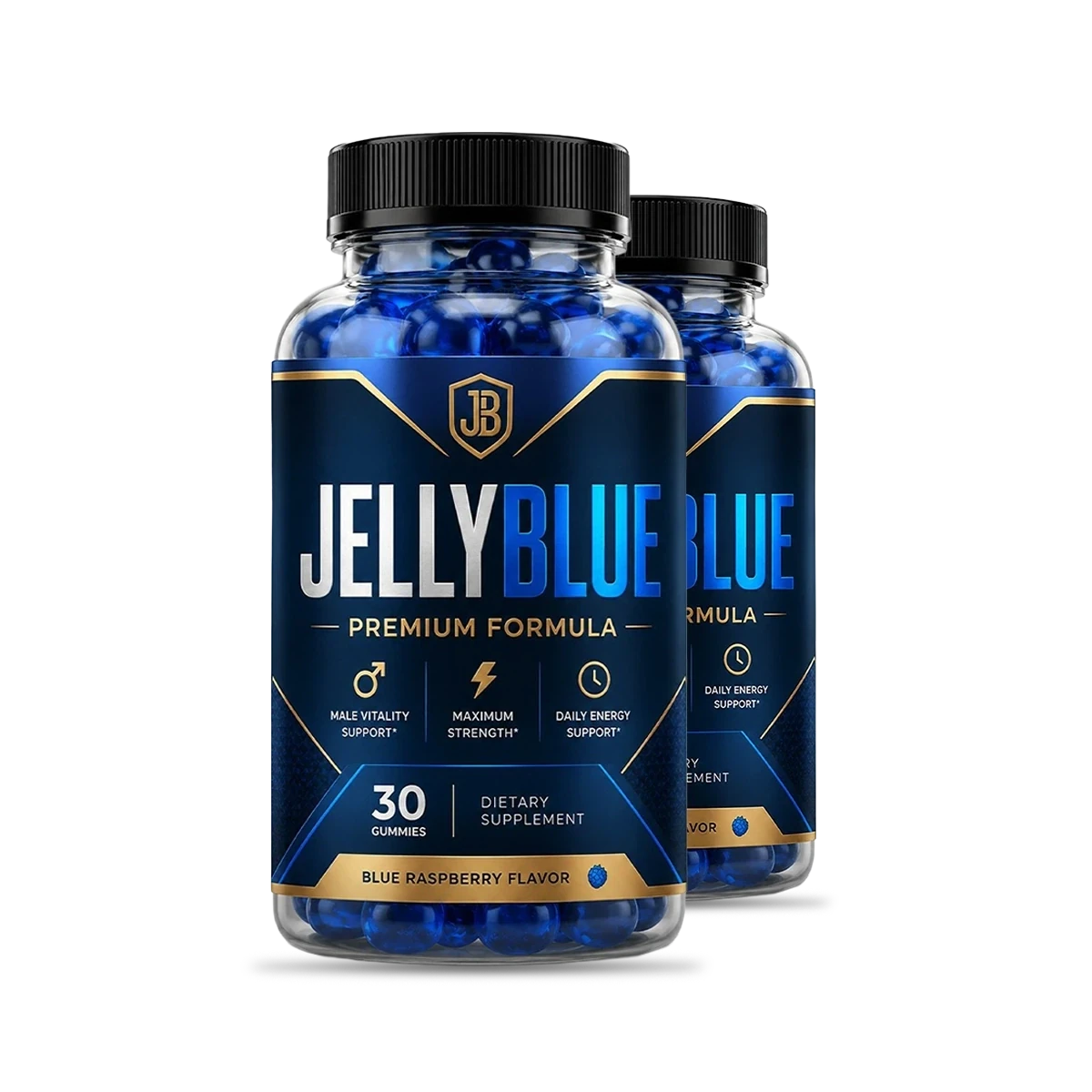
Order JellyBlue and read the panel before the first gummy
Seven actives at printed amounts, one gummy a day, sixty days from purchase to change your mind.
Two bottles $158 · six bottles $294 · 60 days from the day you pay, opened bottles accepted
Order JellyBlue On The Official WebsiteOne gummy a day · 30 to a bottle · lot JEL-26/JE-5599