JellyBlue Official Website › Blog › Four Of Seven
Four Of Seven: The JellyBlue Actives That Share One Blood-Vessel Pathway
Seven actives sit on this panel, and they are not all doing the same job. Four of them - tongkat ali, beet root, grape seed and L-arginine HCl - turn up again and again in a different body of research: studies of blood-vessel tone, nitric oxide and blood pressure. None of that research was designed around a gummy that combines all four in one serving, and that gap is what this post is about.
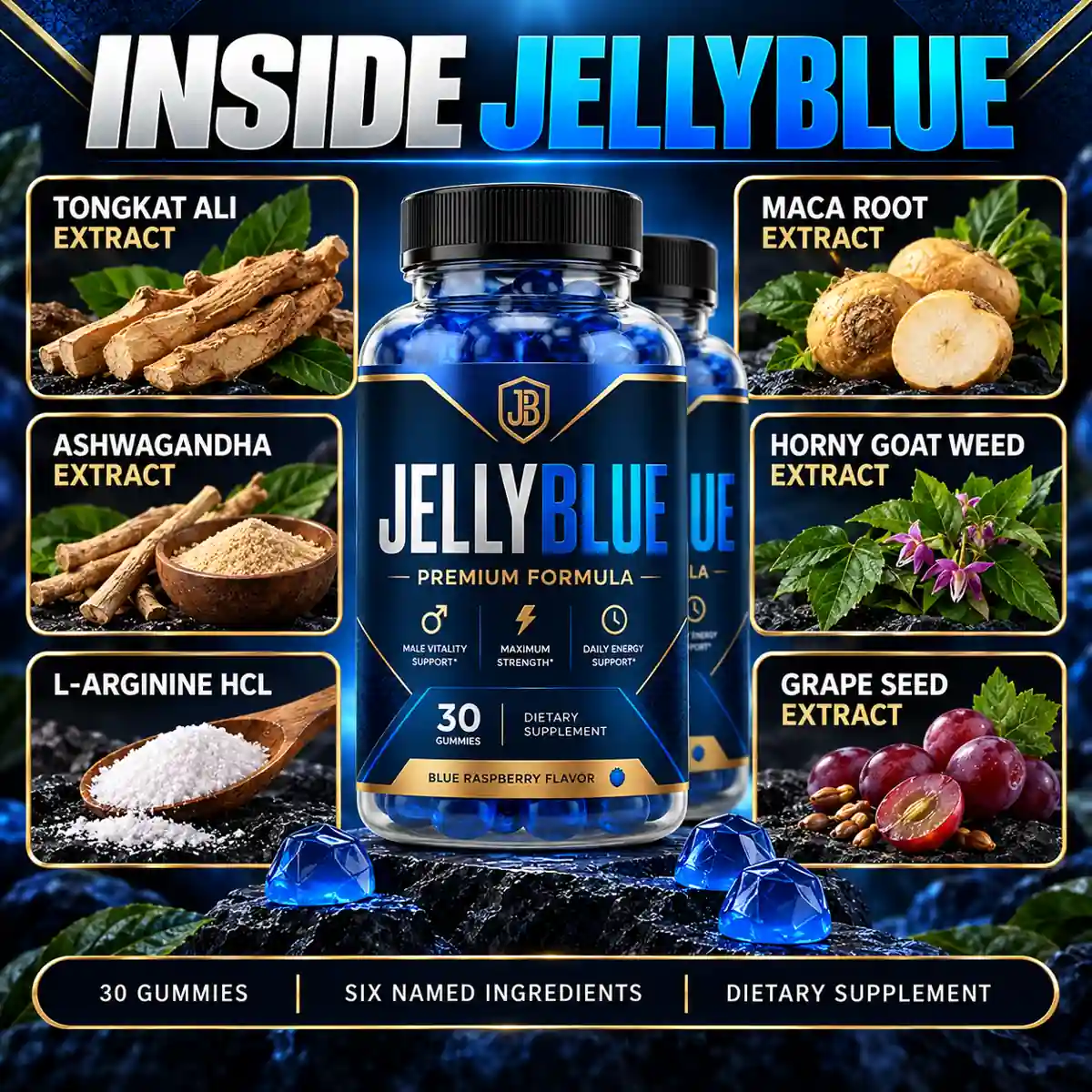
- Tongkat ali, beet root, grape seed and L-arginine HCl together carry 350 mg of this panel's 650 mg total.
- Each one, studied on its own, has published research measuring blood pressure, nitric oxide or blood-vessel relaxation.
- The doses used in that research are, in every case, well above what one gummy provides.
- No trial has tested these four together, at these amounts, in one product.
- The label's own caution line already tells anyone with a known medical condition to ask a physician first - this post is about why that line is doing real work for this particular panel.
Four names, one target
A supplement panel lists ingredients in whatever order the label designer chose. It does not group them by what they do inside the body. Read the JellyBlue panel that way instead - by mechanism rather than by order printed - and four of the seven rows sort into the same pile.
| Active | Amount on this panel | What its own research measures |
|---|---|---|
| Tongkat ali (Eurycoma longifolia) | 200 mg | Vessel relaxation, angiotensin pathway, serum testosterone |
| Beet root (Beta vulgaris) | 50 mg | Blood pressure, via dietary nitrate |
| Grape seed (Vitis vinifera) | 50 mg | Blood pressure, heart rate, flow-mediated dilation |
| L-Arginine HCl | 50 mg | Blood pressure, via nitric oxide synthesis |
Four rows, 350 mg combined, and one shared organ system across all four bodies of research: the wall of a blood vessel.
Maca, ashwagandha and horny goat weed are the other three rows on this panel, and their own published research runs in different directions - hormone levels, mood scores, and in horny goat weed's case, no human trial at all. This post leaves those three where they are and looks only at the four that converge.
Tongkat ali: relaxing the vessel wall
Tongkat ali's best-known human research measures testosterone, and that work is covered on this site's dosage analysis of the 200 mg row. A separate line of research, done in animals rather than people, looked at what the root extract does to a blood vessel directly.
A 2016 laboratory study took aortic rings from rats, pre-contracted them with a vasoconstrictor, and tested fractions of Eurycoma longifolia root extract against them. One fraction relaxed the rings significantly. Follow-up work in the same paper found that fraction blunted the contraction caused by angiotensin I and angiotensin II, enhanced a bradykinin-driven relaxation, and inhibited angiotensin-converting enzyme (ACE) in a test tube. That is the same enzyme that ACE-inhibitor blood pressure medicines target.
This is bench research on isolated rat aortic rings, not a clinical trial in people, and the paper's own title calls it a "first report." It establishes a plausible mechanism - ACE inhibition and vessel relaxation - rather than a measured effect on a living person's blood pressure. It is included here because a plausible shared mechanism with an ACE-inhibitor drug is exactly the kind of thing worth knowing about before combining tongkat ali with a blood pressure prescription, even though it is early-stage evidence.
Beet root: nitrate, and a split result
Beet root's blood pressure research is built almost entirely around its nitrate content, which the body converts to nitric oxide - a molecule that relaxes blood vessels from the inside. A 2024 meta-analysis of eleven randomised trials in adults with hypertension found that beetroot juice reduced clinical systolic blood pressure by 5.31 mmHg against placebo, at daily nitrate intakes of 200 to 800 mg from the juice. The same paper rated the certainty of that evidence as low.
Not every study agrees. A 2026 meta-analysis that pooled six trials of chronic sodium nitrate supplementation - excluding beetroot juice itself - found no significant reduction in systolic or diastolic blood pressure, and concluded the current evidence does not support a blood-pressure benefit from nitrate supplementation in older adults. Put the two papers side by side and the honest reading is that nitrate's effect on blood pressure is real enough to keep studying and not settled enough to promise.
Neither trial used a beet root extract measured in milligrams the way this panel does. Both used a nitrate dose from juice, which this website's dose-matching post already flagged as not convertible to an extract weight.
Grape seed: a smaller, steadier effect
Grape seed extract's cardiovascular research looks at proanthocyanidins, a group of plant compounds studied for their effect on blood vessels. A 2022 meta-analysis of controlled trials found that grape seed extract significantly lowered diastolic blood pressure by 2.20 mmHg and heart rate by 1.25 beats per minute, though it found no significant effect on systolic pressure or on flow-mediated dilation, a direct measure of how well an artery widens.
A smaller, more recent study looked at the mechanism more closely. A 2025 crossover trial in ten men with elevated or stage 1 blood pressure gave seven days of grape seed extract and measured resting blood pressure, heart rate and heart-rate variability. Diastolic pressure and mean arterial pressure both fell compared with placebo, and the authors concluded the reduction came from peripheral vasodilation rather than a change in the nervous system's control of the heart - a vessel-level effect, not a heart-rate effect.
L-arginine: the largest published effect, at the largest gap in dose
L-arginine is the amino acid the body uses to build nitric oxide directly, and its blood-pressure research is the most extensive of the four. A 2022 dose-response meta-analysis of 22 randomised trials found L-arginine supplementation significantly reduced systolic blood pressure by 6.40 mmHg and diastolic blood pressure by 2.64 mmHg on average, with the effective dose for systolic pressure identified at 4 grams a day or more.
A newer meta-analysis narrows the picture further. A 2026 review of five trials using 24-hour ambulatory blood pressure monitoring - a stricter measurement than a single cuff reading - found oral L-arginine reduced 24-hour systolic pressure by 4.23 mmHg and 24-hour diastolic pressure by 3.04 mmHg, with larger reductions recorded at night than during the day.
The dose-response meta-analysis puts the effective threshold for L-arginine's systolic effect at 4,000 mg a day. This panel prints 50 mg. That is a gap of roughly eightyfold, and it is the largest ratio in this post - larger than the gaps this site's own dosage analysis found for maca or ashwagandha.
The doses in the trials against the doses on this panel
| Active | On this panel | Dose with a measured vascular effect | Gap |
|---|---|---|---|
| Tongkat ali | 200 mg | Not dose-mapped — animal tissue study, no human dose tested | Not comparable |
| Beet root | 50 mg | 200-800 mg of nitrate a day, from juice | Not comparable |
| Grape seed | 50 mg | Most pooled trials used 150-800 mg a day | Roughly 3-16× |
| L-Arginine HCl | 50 mg | ≥4,000 mg a day for the systolic effect | Roughly 80× |
Every trial dose in the third column was read out of that paper's own methods section. Three of four rows are not comparable or sit far below the studied range - the same pattern this site has found on every other row of this panel.
Why four is a different question than one
Everything above describes what happens when one ingredient is studied on its own, usually at a dose well above what a single JellyBlue gummy provides. No published trial has tested tongkat ali, beet root, grape seed and L-arginine together, at 200 mg, 50 mg, 50 mg and 50 mg, in one product. That combination simply has not been studied as a combination.
A 2021 review of food-drug interactions in hypertension makes the general point this post is built on: bioactive compounds in food and supplements can modulate the same mechanisms - vasodilation, the renin-angiotensin system, nitric oxide - that prescription antihypertensive drugs target, and the review's own practical guidance is that combined use of food or supplement compounds with antihypertensive drugs warrants precaution.
- Four separate small effects on vessel tone are not automatically additive, and nothing in the four papers above measured them combined.
- Each dose on this panel is below - often far below - the amount that produced a measured effect in its own research, which cuts against a large combined effect at these amounts.
- The uncertainty runs in both directions: it is also why nobody can rule a combined effect out from the evidence that exists.
- The panel's own caution line - consult a physician if you have a known medical condition - covers exactly this kind of unstudied combination, and it is the one instruction on the label built for a question research alone cannot answer yet.
See all seven JellyBlue actives, and the doses behind them
Four rows share a blood-vessel pathway. Three do not. Every amount is printed on the panel and set beside its own published research on this site.
Two bottles $158 · three bottles $207 · six bottles $294 · 60 days from the day you pay, opened bottles accepted
Order JellyBlueOne gummy a day · 30 to a bottle
What this post is not saying
This is not a claim that JellyBlue lowers blood pressure, and it is not a claim that it raises any risk for a specific person - neither claim is supported by a trial of this product. It is a description of four published, independent lines of research that all point at the same organ system, sitting in one gummy at doses mostly below where that research measured an effect. Anyone taking blood pressure medication, a nitrate drug, or any prescription who is considering this or any supplement should read the Supplement Facts panel and talk to a physician first, which is what the label's own caution line already says.
References
- Tee BH, Hoe SZ, Cheah SH, Lam SK. First Report of Eurycoma longifolia Jack Root Extract Causing Relaxation of Aortic Rings in Rats. Biomed Res Int. 2016;2016:1361508. PMID 27800486. https://pubmed.ncbi.nlm.nih.gov/27800486/
- Grönroos R, Eggertsen R, Bernhardsson S, Praetorius Björk M. Effects of beetroot juice on blood pressure in hypertension according to European Society of Hypertension Guidelines: A systematic review and meta-analysis. Nutr Metab Cardiovasc Dis. 2024;34(10):2240-2256. PMID 39069465. https://pubmed.ncbi.nlm.nih.gov/39069465/
- Forster D, Waclawovsky G, Stefani GP. Effects of chronic nitrate supplementation on blood pressure in adults: a systematic review and meta-analysis of randomized clinical trials. Nutr Res. 2026;146:111-120. PMID 41619653. https://pubmed.ncbi.nlm.nih.gov/41619653/
- Shiraseb F, Asbaghi O, Bagheri R, Wong A, Figueroa A, Mirzaei K. Effect of l-Arginine Supplementation on Blood Pressure in Adults: A Systematic Review and Dose-Response Meta-analysis of Randomized Clinical Trials. Adv Nutr. 2022;13(4):1226-1242. PMID 34967840. https://pubmed.ncbi.nlm.nih.gov/34967840/
- Shi Y, Liu Y, Zhou Z, Xu S, Luo P. Reassessment of the effect of oral l-arginine on blood pressure: A systematic review and meta-analysis based on ambulatory blood pressure monitoring. Nitric Oxide. 2026;164:60-68. PMID 42520885. https://pubmed.ncbi.nlm.nih.gov/42520885/
- Foshati S, Nouripour F, Sadeghi E, Amani R. The effect of grape (Vitis vinifera) seed extract supplementation on flow-mediated dilation, blood pressure, and heart rate: A systematic review and meta-analysis of controlled trials with duration- and dose-response analysis. Pharmacol Res. 2022;175:105905. PMID 34798267. https://pubmed.ncbi.nlm.nih.gov/34798267/
- Lira A, Boyer W, Gillum T, Sullivan S, Kim JK. Effect of 7-day dietary supplementation with grape seed extract on cardiac autonomic and hemodynamic responses in elevated and stage 1 hypertension. Clin Physiol Funct Imaging. 2025;45(3):e70010. PMID 40341867. https://pubmed.ncbi.nlm.nih.gov/40341867/
- Ajeigbe OF, Ademosun AO, Oboh G. Relieving the tension in hypertension: Food-drug interactions and anti-hypertensive mechanisms of food bioactive compounds. J Food Biochem. 2021;45(3):e13317. PMID 32537763. https://pubmed.ncbi.nlm.nih.gov/32537763/
More about JellyBlue
Order JellyBlue knowing what four of its actives share
Tongkat ali, beet root, grape seed and L-arginine, and the published research behind each one, printed on this site.
Two bottles $158 · six bottles $294 · 60 days from the day you pay, opened bottles accepted
Order JellyBlueOne gummy a day · 30 to a bottle